Portraiture
Snow Is the Studio
For Chanel's Coco Neige 2026 campaign, Julien Martinez Leclerc treats a whiteout as a seamless backdrop and a portrait sitting as a game of scale. On photographs that hold their nerve, and on tweed asked to work at altitude.
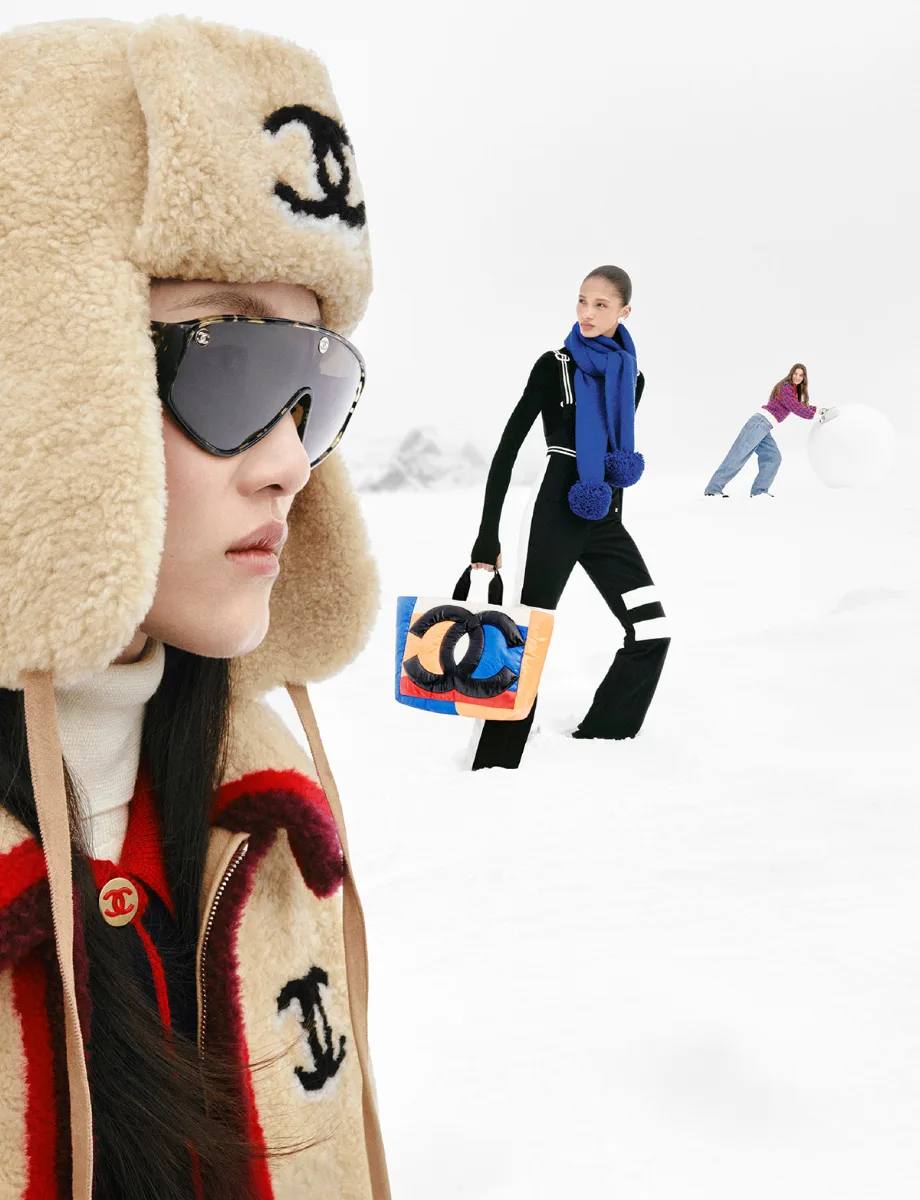
The first photograph in the Coco Neige 2026 campaign is a trick of distance, and it is honest about being one. At the left edge, cropped hard by the frame, a model in profile wears a beige shearling chapka and a dark shield visor, her face filling a third of the picture. Deep in the white behind her, a second figure in black with a cobalt scarf strides past carrying a colour blocked tote, and further back still, a third figure in jeans leans into a snowball nearly her own height. Three scales, one flat white ground, no horizon to correct them. The eye assembles a landscape out of people.
That is the campaign's method, and it is a portraitist's method before it is a fashion one. Julien Martinez Leclerc, who photographed the campaign, uses snow the way a studio photographer uses seamless paper: as a ground so blank that placement becomes the whole composition. The models, Elodie Guipaud, Feng Jiao Long and Lia Marie Mielke, are not arranged in a scene so much as distributed across a page, near, middle and far, like figures in a diagram of depth. Nothing in the frame competes with them. The mountain has been politely asked to leave, and what remains is the sitting.
The face, withheld
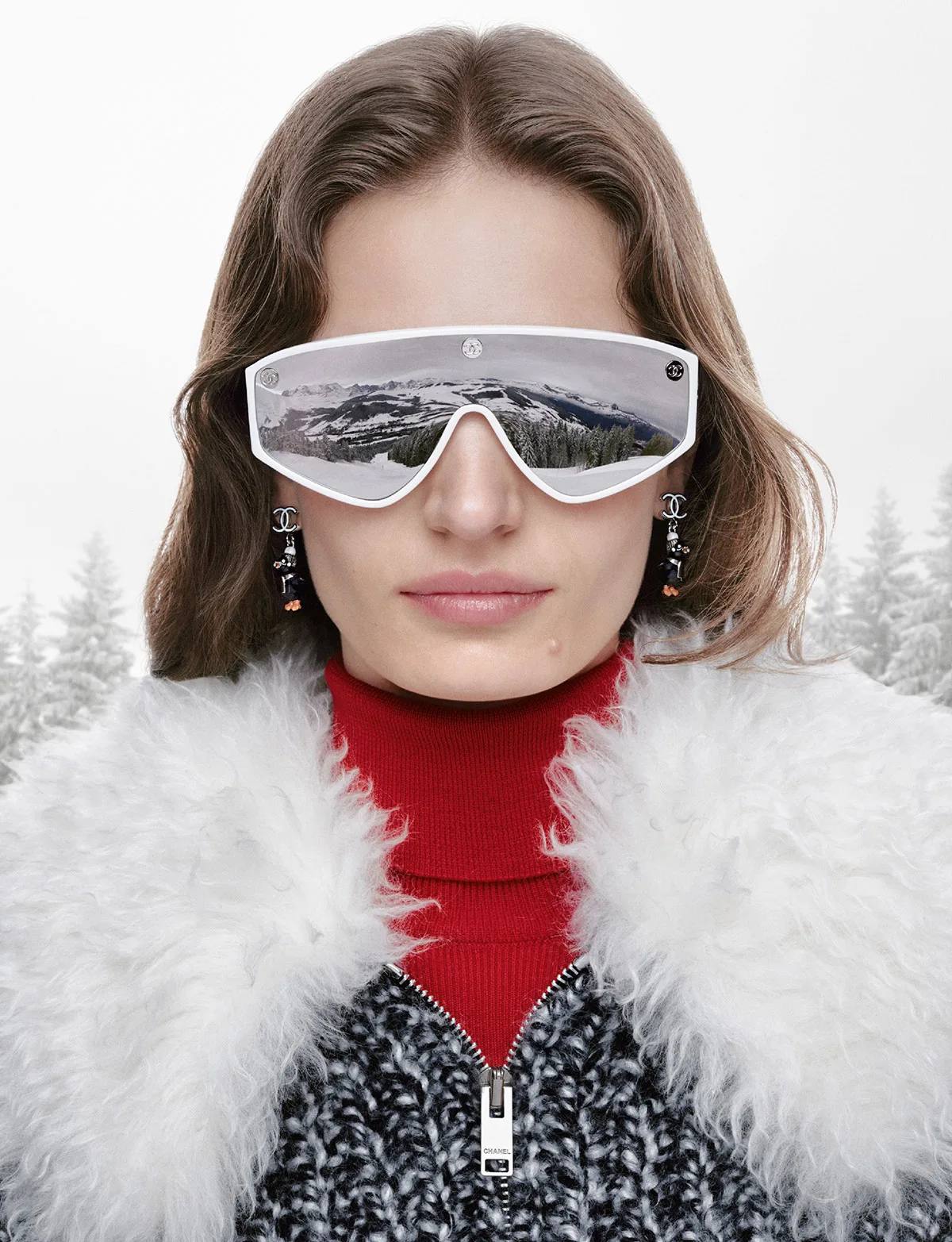
The closest portrait in the set makes the point by refusal. A model faces the camera squarely, close enough that her shoulders fill the lower frame, and her eyes are gone. In their place, a mirrored shield visor reflects a complete alpine panorama: ridge, treeline, snowfield, a whole landscape held where the gaze should be. Below the visor, small penguin earrings dangle at each ear, and a red turtleneck rises into a collar of white shag, over a black and white chunky knit zipped to the throat.
A portrait conventionally promises a person and delivers, at best, an arrangement. This one admits the arrangement. By replacing the sitter's eyes with the view she would be looking at, the photograph swaps the two halves of landscape portraiture: the watcher becomes the watched view. It should feel like a gimmick, and in a weaker frame it would. What saves it is scale discipline. The joke at the ears is tiny, the landscape in the visor is rendered with postcard clarity, and the face between them stays calm and unsmiling. The picture trusts the viewer to hold all three registers at once.
Leclerc comes to this campaign as a returning hand rather than a new discovery: Models.com also credits him with the house's Fall 2026 campaign, listed in September. The Coco Neige pictures share that season's appetite for flatness, for figures placed against emptied grounds and allowed to read as graphics first and people second. Read as portraiture, the work is cool to the point of severity. Read as campaign craft, the severity is the service being sold: on a white ground, nothing is remembered except the clothes and the logo, and the clothes are given every chance to be remembered in detail.
Tweed, taken seriously
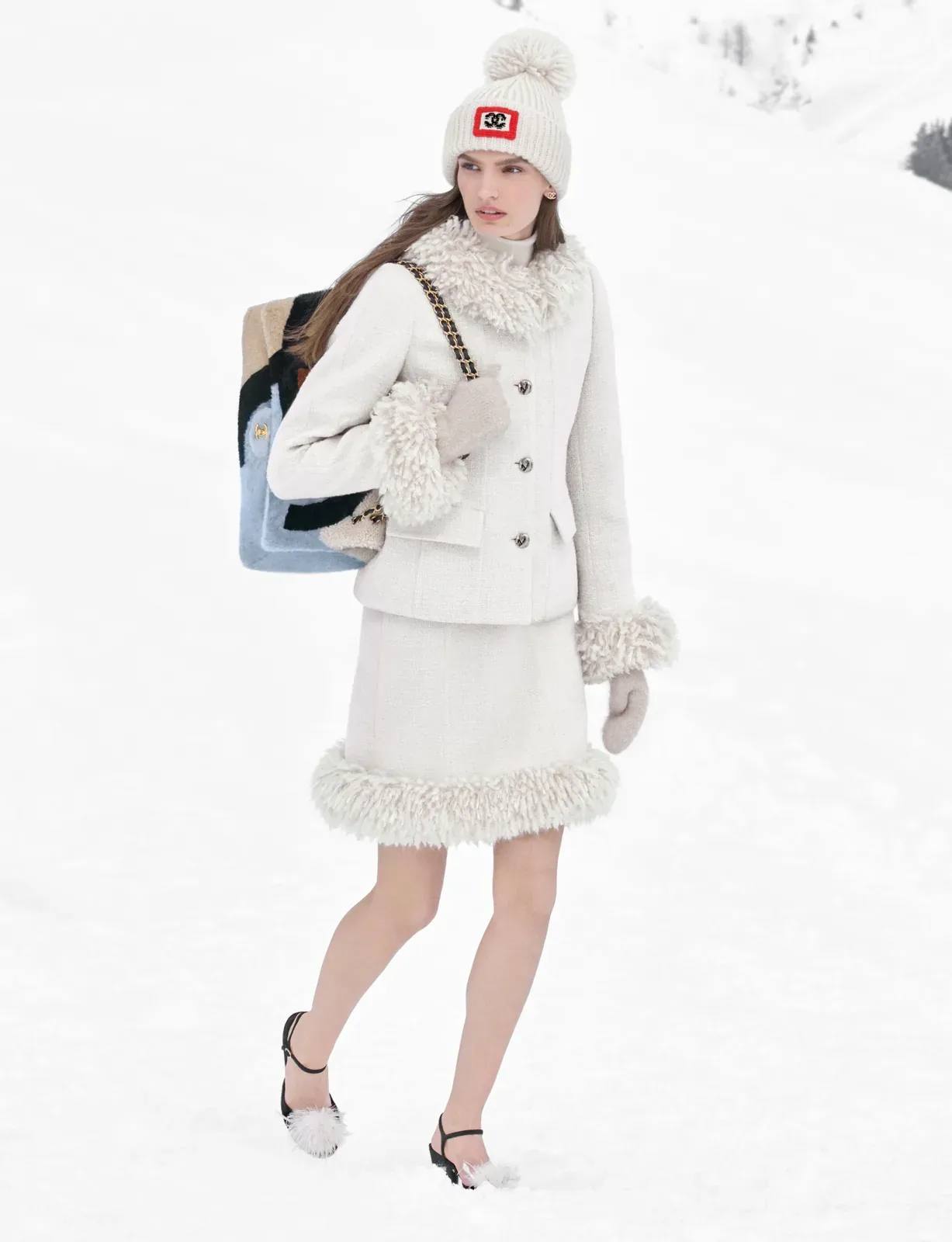
Which brings the argument to the material. The second movement of these pictures is a craft story, and its central exhibit is a suit. One frame shows a model mid stride in the snow wearing a white tweed jacket and skirt, the house's signature cloth cut as a matched pair, trimmed at collar, cuffs and hem with a shaggy fringe that reads, outdoors, as frost forming on the garment itself. She wears a knitted pompom beanie, mittens, and an oversized bag on her shoulder, and she is walking through snow in heeled sandals finished with white pompoms. The impracticality is deliberate and beside the point. The point is that the tweed holds its structure in a landscape that flattens everything else. Against snow, a lesser cloth would vanish. This one keeps its edges.
Around that white centre, the collection works the house codes harder. The campaign and collection include colourful check tweeds and graphic two tone stripes, relaxed and sometimes boyish ski suits and jackets set against more tailored pieces, and a vivid red that recurs as a through line against the house palette of black, white and beige, lifted by primary blue and yellow. The warmth is built in layers that the photographs are careful to make legible: lined fabrics, jersey, touches of cashmere and wool. In the chalet frames you can read the layering as texture before you read it as clothing, boucle knits and shearling piled until the surface itself becomes the subject.
The accessories continue the argument at smaller scale. Chanel's own collection listing names the chapka, the Maxi Flap Bag, the Small Camera Case, boots and mittens among the pieces, and the campaign adds lined mules modelled on men's loafers. None of this is photographed as equipment. It is photographed as portrait furniture, the objects a sitting is arranged around.
The penguin problem
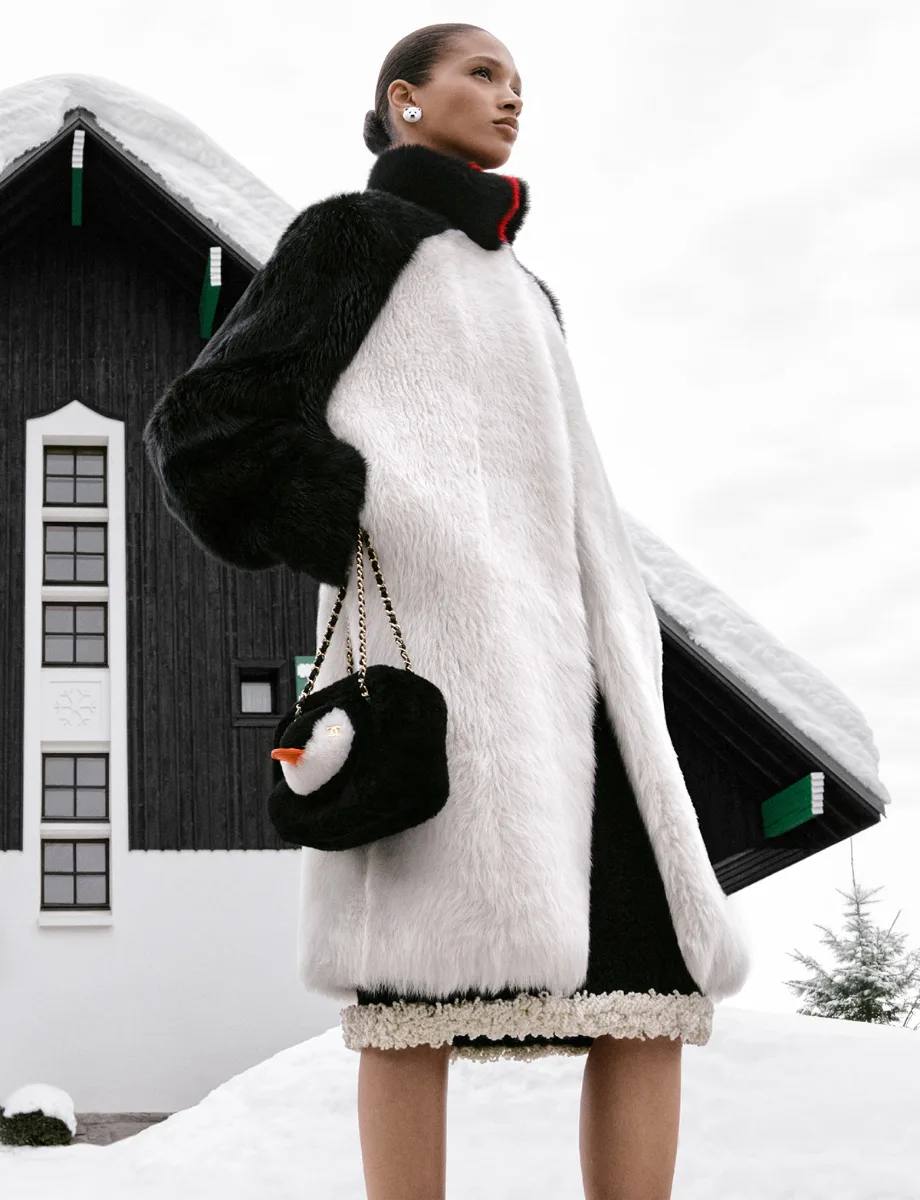
Every playful campaign has a moment where the joke is asked to carry more than it can. Here the joke is zoological. Penguins and polar bears run through the collection, and one frame commits fully: a model stands before a black timbered chalet wearing a long black and white coat that gives her the penguin's own silhouette and plumage, carrying a small black bag shaped as a penguin's head, its orange beak the only warm note in the picture. The chalet behind her repeats the scheme, black boards, white trim, snow on the roof, so the figure reads as architecture that learned to walk.
It is the campaign's best photograph and its riskiest. Best, because the rhyming of coat, bag and building is genuinely witty composition, the kind that rewards a second look. Riskiest, because a motif repeated at three sizes in one frame is one repetition from novelty, and novelty is where craft goes to be forgiven instead of admired. What keeps the frame on the right side of the line is, again, the photography: the model is shot in strict profile, gaze level, posture formal, refusing to perform the joke her clothes are telling. The portrait stays a portrait. The comedy is left to the cloth.
That tension is the honest verdict on the whole set. Coco Neige has run since 2018 as the house's winter capsule, and this edition, the first under Matthieu Blazy according to PurseBlog and RunwayLive, could easily have been photographed as lifestyle: chalets, chairlifts, laughter, steam. Leclerc declines the lifestyle. He builds a studio out of weather, sits his models in it with formal patience, and lets tweed, shearling and one very committed penguin make the case that a portrait sitting, done properly, can happen anywhere the light goes flat and white.