Features
Milwaukee 1980, Given Its Largest Room
Bud Glick photographed Milwaukee's Mexican American and Puerto Rican neighbourhoods in 1980, when he was a student sent out to photograph his own streets. The Widener Gallery now gives the work its most extensive exhibition to date, and the pictures hold up as both document and portrait.
The doorway does the composing. Two young women sit on a patterned sofa in a back room, framed by a door frame, framed again by the room in front of it: family photographs on the walls, a sombrero hung high, and above the sitters a woven Last Supper spread across the wall like a second ceiling. Bud Glick made the photograph in Milwaukee in 1980. He was a photography student, and the assignment, as he tells it, was to photograph his neighbourhood. He kept going.
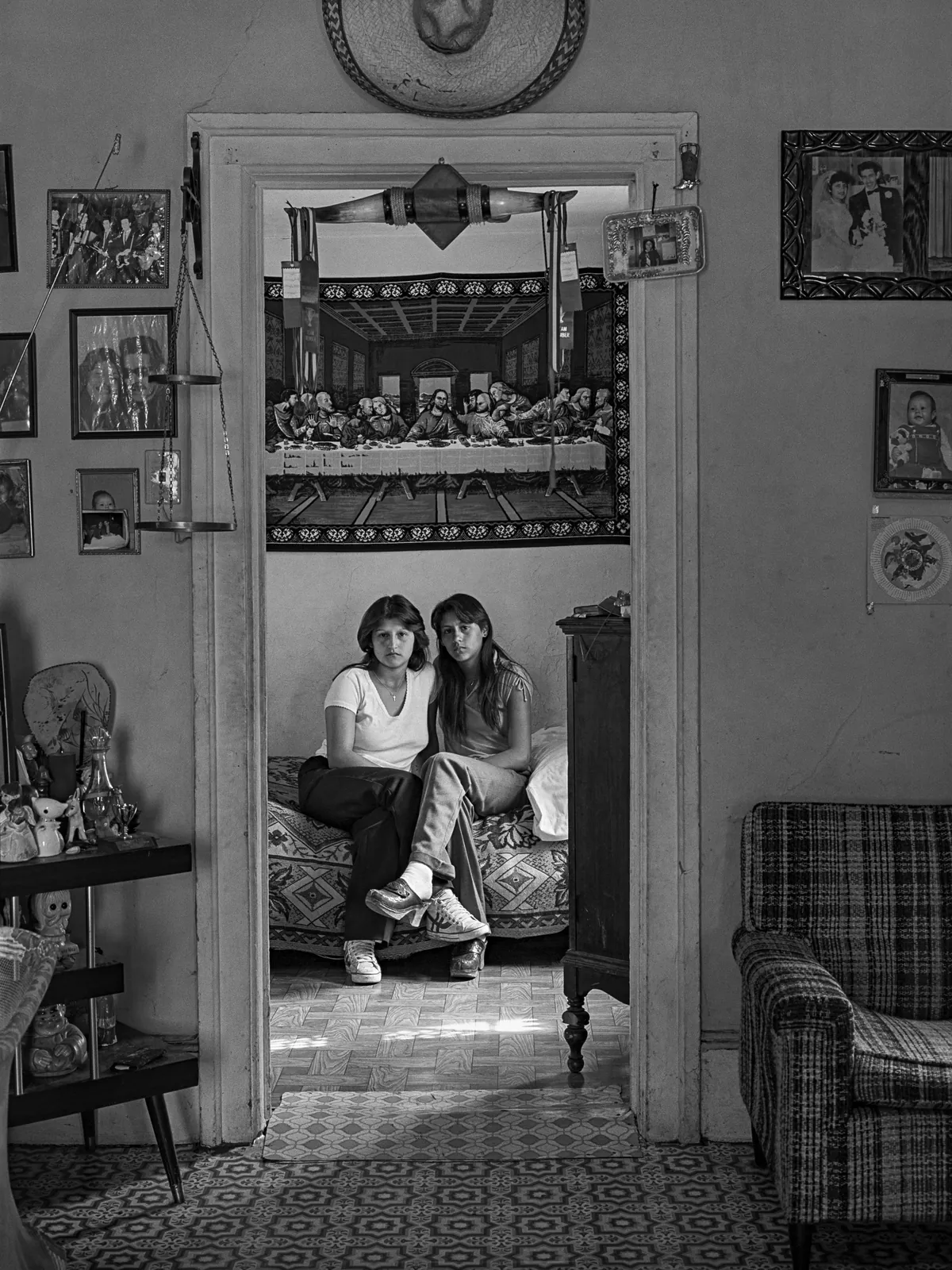
Milwaukee 1980 is now on view at the Widener Gallery in the Austin Arts Center at Trinity College in Hartford, from 16 November 2026 to 24 February 2027. Trinity describes it as the most extensive exhibition of this body of work to date. The photographs document everyday life in Milwaukee's Mexican American and Puerto Rican neighbourhoods, made from inside the routines they show: front rooms, family walls, music in the house.
The accordion photograph is the exhibition in miniature. A man in a cap leans into a button accordion, head bowed to the instrument, in a room where the wall carries a bullfight tapestry, a framed print and a decorated sombrero, and hard sunlight cuts stripes across the plaster. Nothing is arranged for the camera and nothing is hidden from it. Glick's pictures trust interiors to testify. The rooms are dense with images already: tapestries, portraits, religious pictures. His photograph adds one more image to a wall that was never bare.
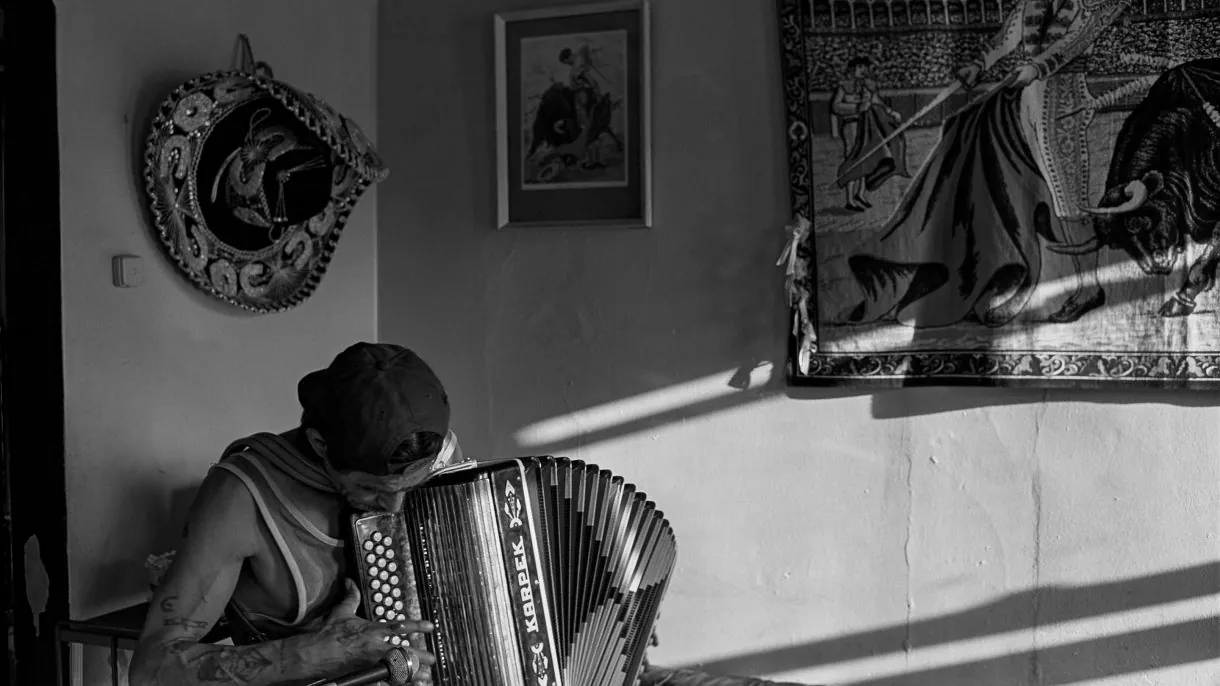
That density is the work's method. These are not street photographs snatched in passing. They are portraits of households, taken at the distance a guest is given, and their authority comes from accumulation: the tiled floor, the plaid armchair, the photographs of relatives hung at three heights. A neighbourhood photographed this way cannot be reduced to a backdrop. It reads as a set of decisions about what to keep in view, made by the people who live there, recorded by a photographer who was learning to see by looking at home.
The exhibition is also a piece of career sequencing. Milwaukee 1980 was the precursor to Glick's Chinatown project, which has been acquired in its entirety by Yale University's Beinecke Library. Seen after Chinatown, the Milwaukee pictures show the approach being formed: enter a community through its domestic spaces, stay long enough for the rooms to stop performing, and let the inhabitants' own pictures share the frame with yours. The student assignment became a working method that later projects inherited whole.
Glick is now Trinity's Visiting Professor of the Practice in Fine Arts, which makes this a homecoming of an unusual kind: the professor exhibiting the student work, in the college's own gallery, forty six years after the negatives were made. He took his BA in history at the University of Wisconsin and his MFA in photography at Brooklyn College. From 2018 to 2019 he held a solo exhibition at the Museum of Chinese in America, and his work sits in the collections of the Beinecke Library, the Museum of Chinese in America, the New York Public Library and Latino Arts, United Community Center, Milwaukee.

The Widener presentation is free and open to the public, sponsored by the Department of Fine Arts, with gallery hours Monday to Friday, 10 am to 5 pm. A public reception was held on 19 November and a gallery talk followed on 23 November. The run pauses for the college calendar, closed 25 to 29 November and again from 15 December to 24 January, before closing on 24 February 2027.
What justifies the largest room this work has had is not nostalgia. The photographs were made in 1980, in neighbourhoods that American photography usually visited as a subject rather than joined as a resident. Glick's pictures hold because they were made at household distance, with the sitters' own image worlds left standing in the frame. The exhibition asks the visitor to do what the student did: start with the room you are in, and take its pictures seriously. Forty six years on, the rooms still answer.