Features
In Venice, the Dance and the Garden
At Le Stanze della Fotografia, two exhibitions presented by Van Cleef & Arpels put more than 200 prints to a single question: what can a still photograph hold of things that move and things that grow.
The dancer is a dark shape inside a darker one. She spins at the edge of a stage with a great fall of black fabric turning around her, her face lit for an instant inside the rotation, and the photograph catches the moment when costume, body and motion become a single object. It is the kind of frame the three photographers in Photo / Dance; Reflections were sent out to find, and from 10 November 2026 it can be seen at Le Stanze della Fotografia in Venice, where two exhibitions presented by Van Cleef & Arpels run together to 27 January 2027: the dance show, and Juliette Agnel's What the Garden Whispers. Between them they hold more than 200 prints, and they divide, neatly, the two subjects photography is worst at and most devoted to: movement, and slowness.
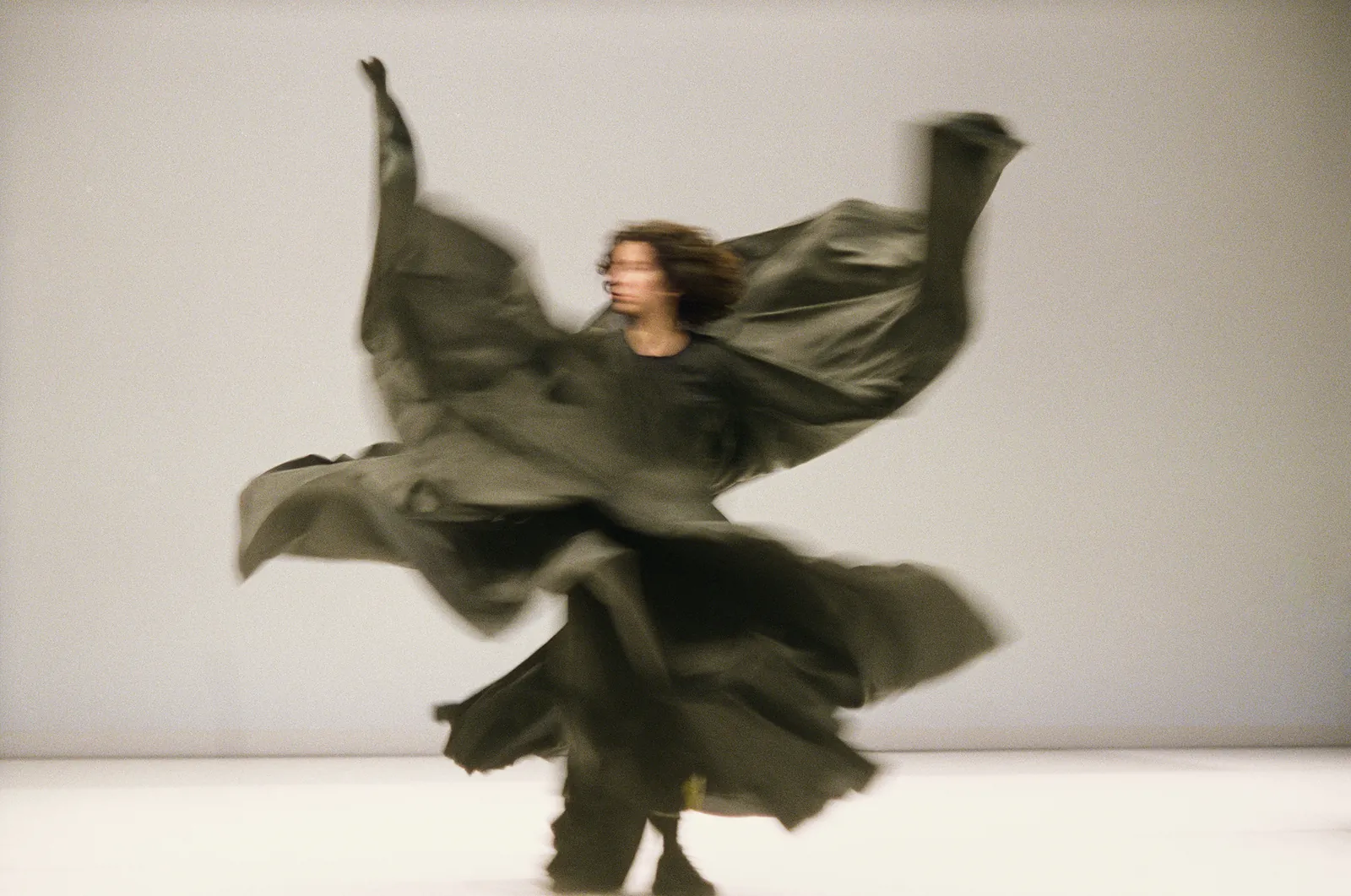
Le Stanze della Fotografia occupies the island of San Giorgio Maggiore, across the water from St Mark's, and it exists for exactly this kind of pairing. It is a joint initiative of Marsilio Arte and the Fondazione Giorgio Cini, continuing a path begun in 2012 at the Casa dei Tre Oci, founded on the conviction that photography deserves a home of its own in Venice. The Van Cleef & Arpels presentation is not a sponsorship pasted onto unrelated art. The maison has drawn on dance and nature since its early decades: its passion for dance dates to the 1920s, it made its Dancer clips in the 1940s, and George Balanchine's ballet Jewels, which it inspired, debuted in 1967. Since 2020 its Dance Reflections programme has supported contemporary choreographic creation internationally. These exhibitions are that history, handed to photographers.
Three cameras at the festival
Photo / Dance; Reflections brings together Rinko Kawauchi, Olivia Bee and Estelle Hanania, three photographers who have collaborated with the maison for several years and who were given complete creative freedom to follow choreographers and dancers through editions of the Dance Reflections festival, on stage and behind the scenes, from the rehearsal room to the performance. The itinerary of their looking is a map of the festival itself: London in 2022 and 2025, New York in 2023 and 2026, Hong Kong and Kyoto in 2024, Seoul in 2025. One company, (LA)HORDE, was followed by all three photographers, and becomes the common denominator of the show, the same dancers read by three incompatible temperaments.
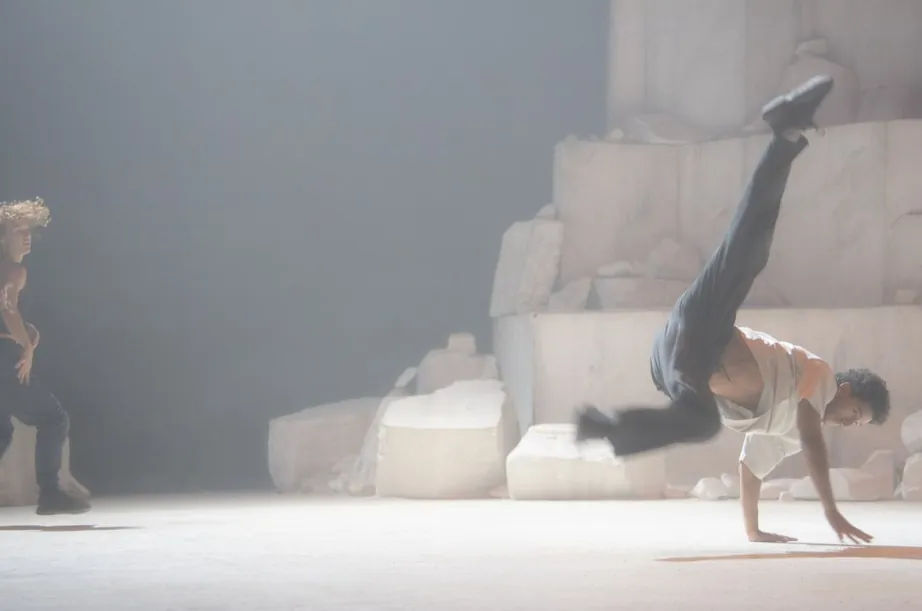
The temperaments are the exhibition. Kawauchi, born in 1972 and a winner of the Kimura Ihei Award, is among the most admired Japanese photographers working, and she brings to dance the same attention she brings to everything: a search for the fragility and the ephemeral nature of living beings, movement dissolved into light. Bee, the American photographer and filmmaker who established herself young with the 2016 monograph Kids in Love, works in analogue prints formed in a dialogue with the festival that began in 2019, fascinated by the magic of the everyday and the beauty of memories. Hanania, the French photographer trained at the École des Beaux-Arts in Paris and known for a long collaboration with the choreographer Gisèle Vienne, treats the dancer's routine, which she has followed since 2022, as sculptural and totemic material. In one of the frames reproduced here a dancer balances on his hands among pale stone blocks on a lit stage, one leg kicked high, the body held at the exact point where balance becomes choreography.
The garden, at night
What the Garden Whispers is one artist and one place. Juliette Agnel's subject is the Orto Giardino del Redentore in Venice, recently restored by the Venice Gardens Foundation with support from Van Cleef & Arpels, and the exhibition route holds more than 80 of her images. Agnel first crossed the garden's threshold at the beginning of 2026 and walked its paths by day and by night, attending to what the gallery calls its three souls: the floral, the vegetable garden and the medicinal. At the centre of the installation, on a raised platform, sits an ointment drawn from her research into the healing properties of plants, surrounded by the photographs. The show is conceived as a remedy as much as a display.
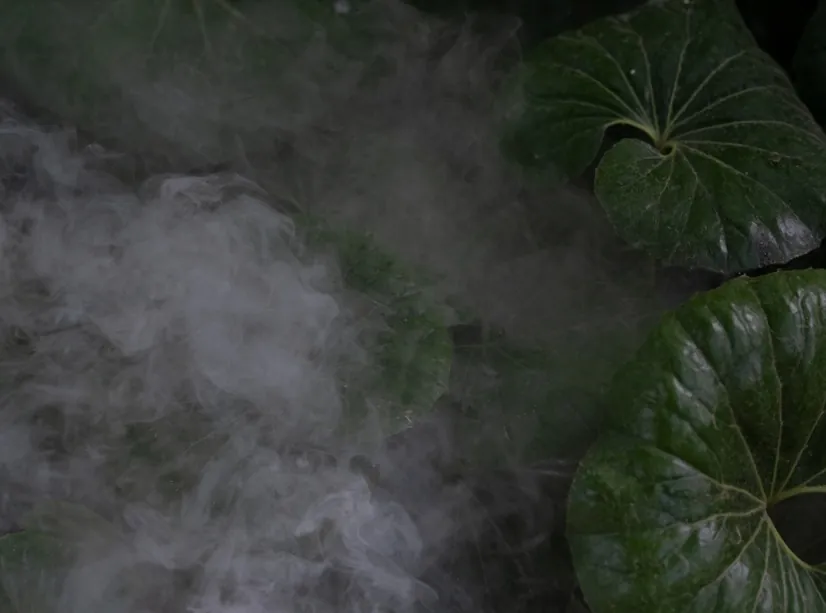
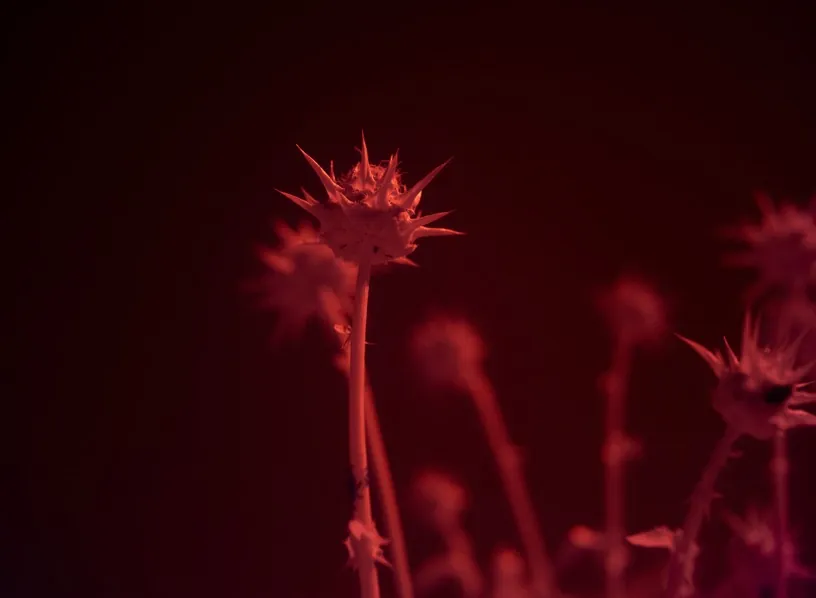
The pictures earn the conceit. One frame is all leaf and mist, a low thicket of green with a single branch of red berries held at its centre like a pulse. Another is a night photograph: a date palm washed in red light against a Venetian wall, flanked by the small green shapes of citrus, the garden rendered as a stage set for a play nobody performs. Agnel's wider work moves between the sky, the earth and prehistoric caves in an attempt, as the gallery puts it, to photograph the invisible, and the garden pictures share that patience. A first selection of the series was shown from August to December 2026 in the Giardino del Convento itself; the Le Stanze presentation, supported by a relationship with the artist that began with the Photo Days in 2023 and continued in Paris and Kyoto, moves the garden indoors and lets it be read slowly, print by print.
The pairing is the argument. The dance photographs were made by chasing something that disappears in a second, across five cities and four years of festivals. The garden photographs were made by returning to one walled plot of Venice until it began to answer. Both exhibitions are about attention paid over time to living things, and both refuse the single definitive image: more than 200 prints is a deliberate excess, a show built from sequences rather than trophies. Venice has no shortage of photography this season, but it does not often get the medium's two oldest problems, how to hold movement and how to hold stillness, hung in adjoining rooms by the same patron. On San Giorgio Maggiore, until 27 January, the problems are open for inspection daily from 11am to 7pm, Wednesdays excepted.