The platinum print is warm before you can name what it shows. Hold one of Irving Penn's late prints and the first thing the eye meets is not the subject but the surface: matte, deep, the darks sitting inside the paper fibers instead of on a glossy skin. Along the sheet edge you can sometimes read the faint brush marks where the sensitizer was laid down by hand. That edge is the whole argument of this piece. For the most controlled fashion photographer of the twentieth century, the photograph was made twice, and the second making was the one that counted.
Penn joined Vogue in 1943 and stayed with the magazine for more than six decades, photographing covers, portraits, still lifes, fashion, and essays for its pages. His first photographic cover appeared in the October 1943 issue. For years, the printing of his work happened somewhere else: in the magazine's reproduction chain, in the hands of engravers and pressmen, at a scale and quality he could not touch. The negative was the beginning of a long journey, and the journey ended wherever the presses stopped.
By the 1970s, Penn had begun to say that the journey was failing him. In 1977, Penn said, "What bothers me now is that, with the smaller size of fashion magazines and less expensive printing, the picture doesn't come to fruition on the page. I feel as if I'm looking at photographs under water." The line is worth sitting with. Penn, who had done more than almost anyone to make magazine photography a serious art, was saying that the magazine could no longer carry his pictures. The response he chose was not to complain louder. It was to take the printing back.
The turn had started more than a decade earlier, in a museum. In 1963, Penn visited the photographic collection at the George Eastman House and was, in his own words, staggered by the nineteenth century prints he saw there: the old photographers had a love for the print, he said, as though it were a painting, and the discovery thrilled him. What drew him was the platinum process, prized for its long gray scale, its capacity to hold what looks like an infinite run of gradations between pure white and absolute black. In 1964 he began making trial prints in platinum, working from negatives he had taken in Japan and from the window of his own studio above Bryant Park, following published procedures by L. P. Clerc and C. B. Neblette. He was forty-seven years old, at the height of his commercial powers, and he was teaching himself a dead process from old books.
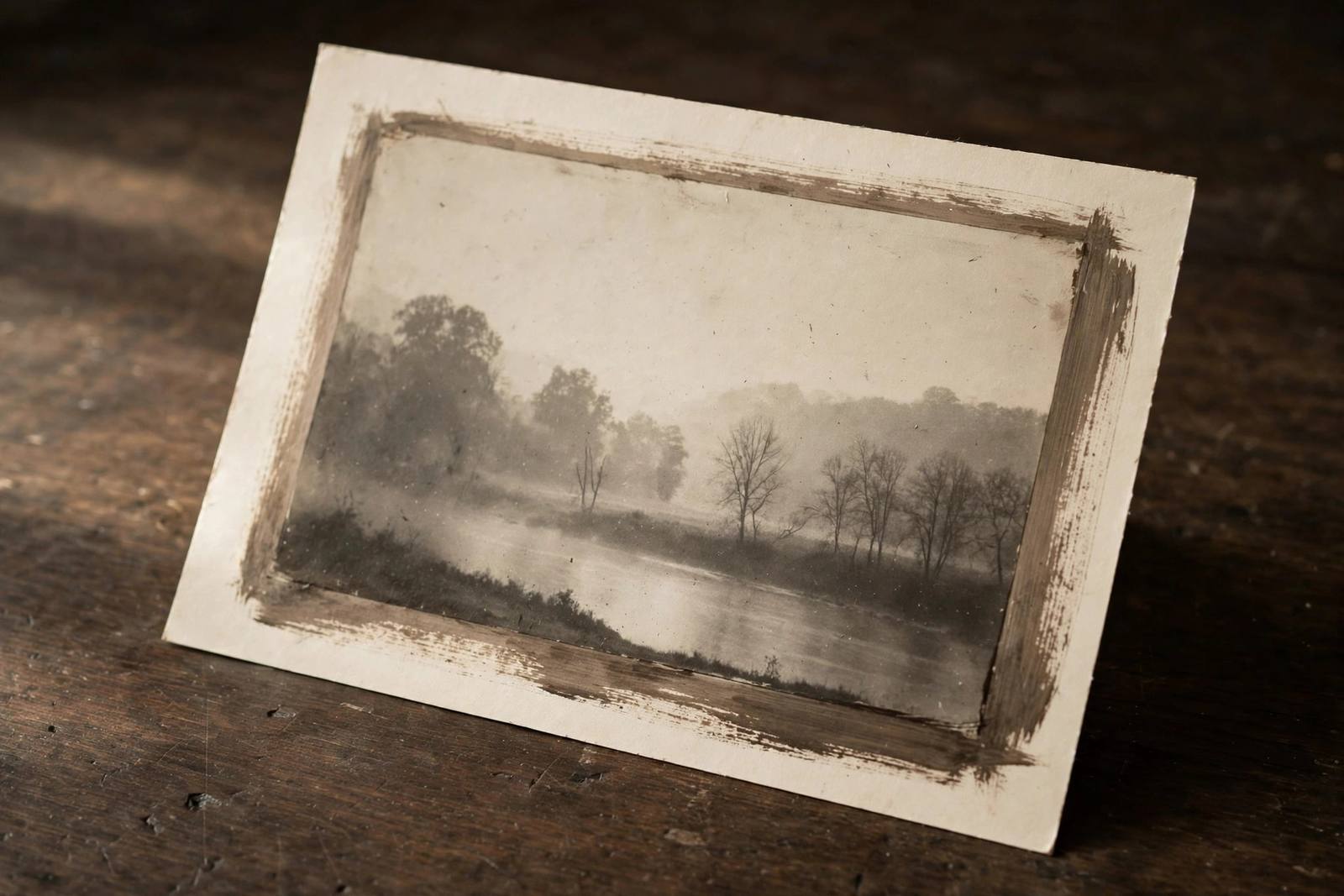
The process itself is simple to describe and brutal to master. Platinum printing is a contact process, so the negative must be the same size as the finished print: Penn first enlarged his camera negatives to the desired dimensions. He hand-coated paper with platinum and palladium sensitizers, let it dry, sandwiched it with the enlarged negative, and exposed it to light. Then, through experiment, he found that recoating the sheet and exposing it a second and third time produced prints of greater depth and subtlety than a single pass could manage. The problem was registration: laying the same negative back onto the same sheet of paper, in exactly the same position, two or three times over. His solution came from the graphic arts. He mounted his paper on aluminum, calling the assemblies plates, and fitted pin registration guides along the edge so the negative and paper could be separated and reunited without drifting. It was pressroom engineering in the service of a hand craft, and it is characteristic of Penn that he solved a problem of touch with a system of metal.
What he did with the system is the point of this history. From the 1960s onward, Penn spent years reprinting his own archive: camera negatives that had previously been printed only in gelatin silver were worked up again, slowly, in platinum and palladium. A fashion still life from 1950, a portrait from the Vogue years, a still life with cigarettes from 1972, all passed through the second negative. The magazine image and the print image diverged, sometimes by decades. The shoot had become the sketch. The darkroom had become the studio.
Penn said that about the metals, and the sentence reverses the usual order of photography. The subject does not dictate the material; the material goes looking for subjects worthy of it. His longtime assistant Vasilios Zatse put the professional verdict plainly: Penn should be regarded, he said, not only as a brilliant image-maker but as a printmaker. The distinction matters. An image-maker serves the assignment. A printmaker answers to the object.
It is worth being precise about what the metals actually do, because Penn's reputation can make the chemistry sound like mystique and it is not. In a gelatin silver print, the image silver sits in a gelatin emulsion that coats the paper. In a platinum print, the metal is absorbed into the paper fibers themselves; there is no emulsion skin, which is why the surface reads as absolutely matte. Platinum's tonal range runs from neutral black through warm black to blue-black, and because the metal is chemically inert, the image resists the decay that attacks silver. Penn, who guarded his emulsion formulas and varied them constantly, often introduced palladium and iron salts into his coatings to steer the color and mood of individual prints. Each sheet was a small experiment with a controlled outcome.

He applied the same appetite to his other printing. His gelatin silver work was anything but straightforward: he burned and dodged with a choreographer's control, and he used selenium toners and bleaching agents to push silver prints far past their standard behavior. For color, he favored the dye transfer process for its saturation and detail, overseeing specialized labs with weeks of proofs and corrections, and when Kodak discontinued the transfer dyes he moved to chromogenic and dye-destruction processes rather than accept a lesser result. In 2003, at eighty-six, his studio acquired its first inkjet printer, and he took to it enthusiastically, directing every stage of the digital editing and printing himself. The through line is not a romance with the antique. It is a refusal to let anyone else finish his sentences.
That refusal is what makes the platinum years a second authorship rather than a retirement hobby. Consider the economics of attention: a Vogue cover is seen by hundreds of thousands of people and lasts a month. A platinum print is seen by one person at a time and lasts, chemically, for centuries. Penn spent his commercial prime feeding the first economy and his mature years building objects for the second. The reprinted archive is not a greatest-hits package. It is a revision, in the writer's sense: the author going back through the manuscript with a sharper pencil, keeping what holds and cutting what was only ever deadline work.
There is a lesson in this for every photographer who has watched a platform compress, crop, or recompress their work into something underwater. The negative, the file, the capture: these are the beginning of the photograph, not the photograph. Penn understood, earlier than most and more completely than most, that the image you release is only as good as the surface it lands on. When the magazines stopped being a surface he could respect, he built his own, one hand-coated sheet at a time, with pin guides along the edge and the patience to expose it three times. The second negative was not a copy of the first. It was the photograph, finally, on his own terms.

The working facts
Penn's platinum work began with first trial prints in 1964, following the published processes of L. P. Clerc and C. B. Neblette, using negatives from Japan and from his studio window above Bryant Park. The method: enlarge the negative to print size, hand-coat paper with platinum and palladium sensitizers, sandwich and expose, then recoat and reexpose two or three times for depth. Registration was solved by mounting the paper on aluminum plates with pin guides adapted from graphic arts practice. Over the following years Penn reprinted large parts of his earlier archive, negatives previously printed only in gelatin silver, in the new metals.
