Criticism
The Camera in the Crowd
Steve McQueen's Resistance opens at Leeds Art Gallery with a century of British protest seen through the photographs that helped make it, and the argument is that the picture was never only a record.
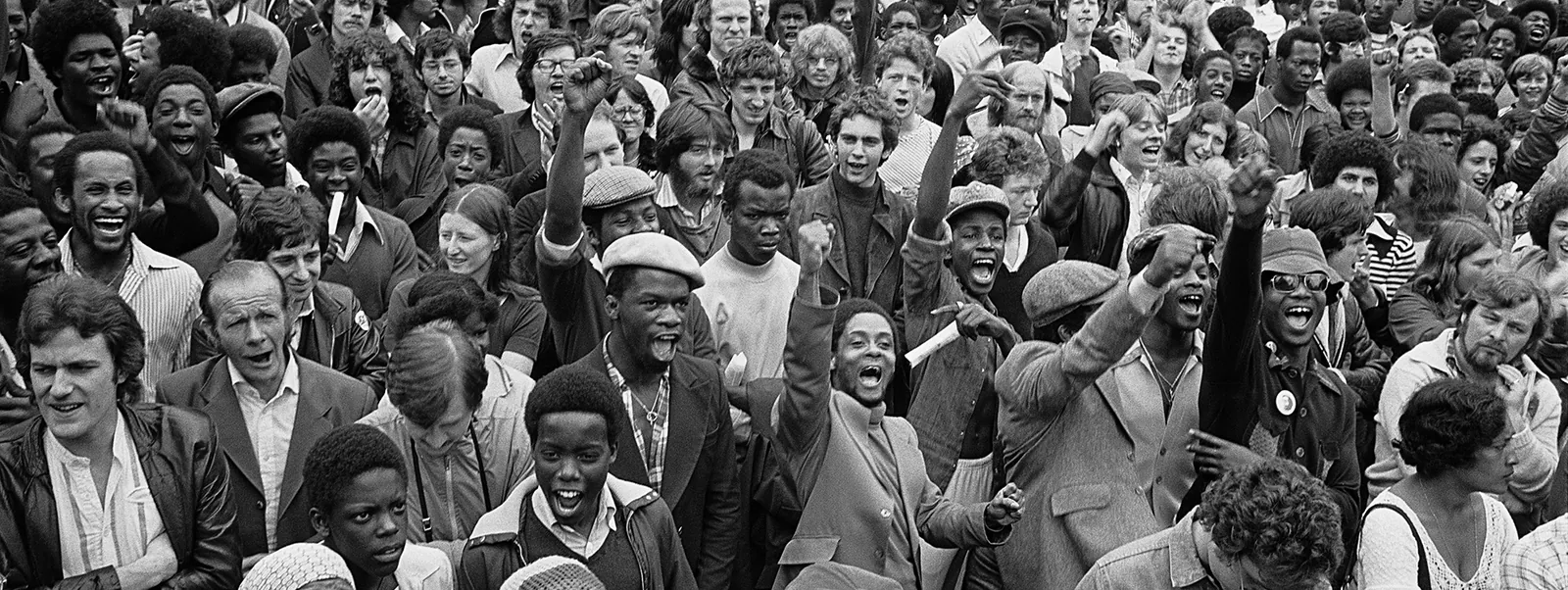
The crowd fills the frame to its edges, and nobody in it is posing. Fists are up, mouths are open, a rolled paper is held like a baton. Paul Trevor photographed anti-racists gathering on New Cross Road in London in August 1977 to block the route of a National Front demonstration, and the picture does what the best photographs in Steve McQueen's Resistance do throughout: it refuses to stand outside the event. The camera is in the crowd, at shoulder height, taking the side of the people it is looking at. That is the exhibition's whole thesis in one frame, and it is why the Leeds presentation of this touring show, which opens at Leeds Art Gallery on 6 November 2026 and runs to 25 April 2027, lands as criticism as much as history.
Resistance is subtitled How Protest Shaped Britain and Photography Shaped Protest, and the second clause is the serious one. Plenty of exhibitions show photographs of demonstrations. This one, conceived by McQueen and curated in collaboration with Clarrie Wallis and Emma Lewis of Turner Contemporary, argues that photography was an instrument inside the movements it pictured, used to recruit, to witness, to accuse and to remember. The span is a full century of activism, from the radical suffrage movement of 1903 to the march against the Iraq War in 2003, which the gallery describes as the largest protest in British history. Between those poles the show gathers work by more than 40 photographers, among them Vanley Burke, Henry Grant, Fay Godwin, Edith Tudor-Hart, Tish Murtha, Humphrey Spender, Christine Spengler, Andrew Testa, Paul Trevor and Janine Wiedel, set alongside less-known names the archives nearly lost.
The early rooms: the state in the frame
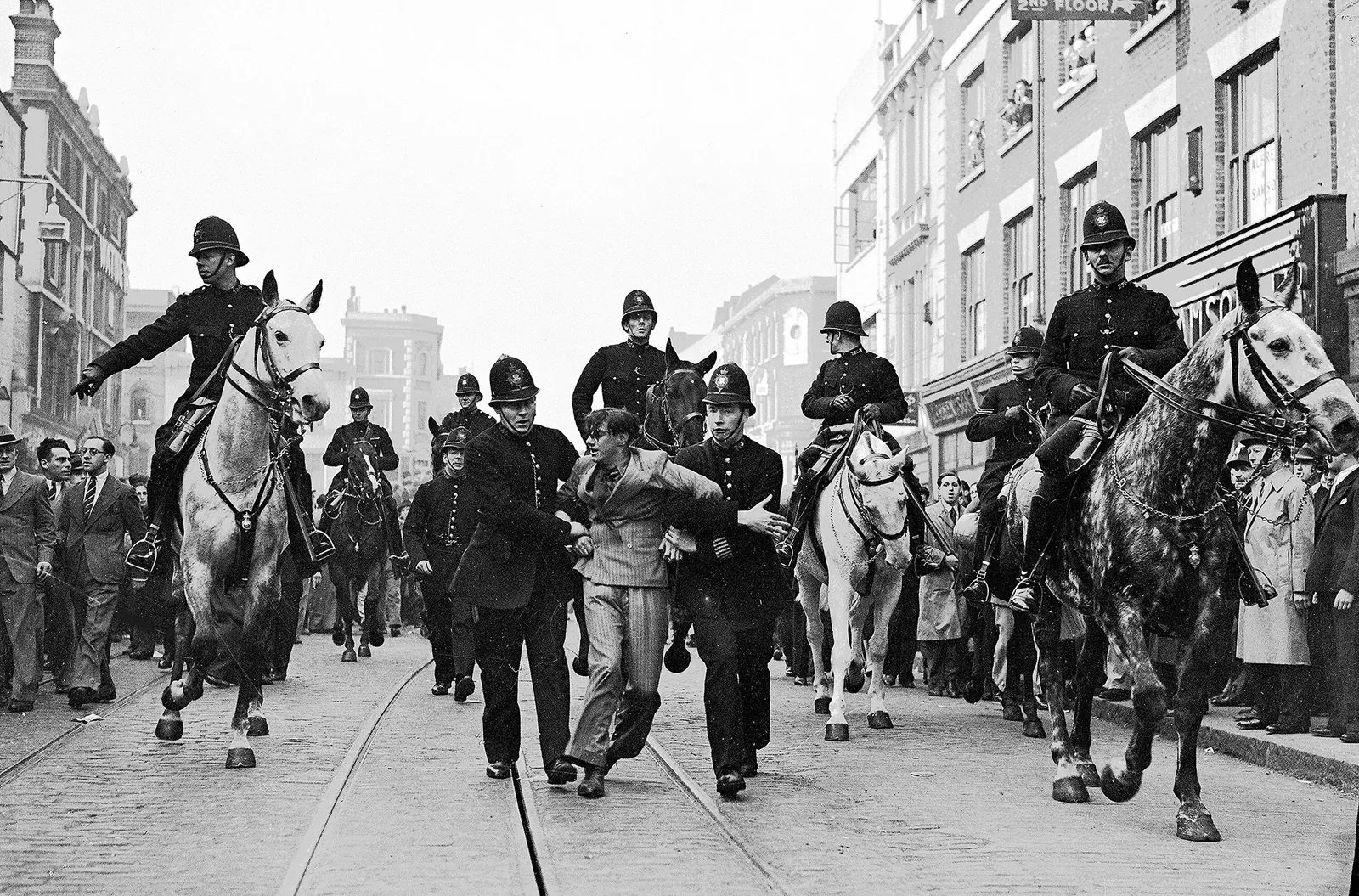
The earliest photograph reproduced here is also the bluntest. At the Battle of Cable Street in London on 4 October 1936, Eddie Worth photographed two officers marching an arrested anti-fascist demonstrator away between mounted police, moments after a baton charge on horseback, and its power is procedural: nobody is striking a heroic attitude, the arrest is simply happening, in daylight, in front of witnesses, one of whom had a camera. Resistance returns to this quality again and again. The photographs were drawn from archives, collections and image libraries, and the exhibition deliberately concentrates on moments captured before digital cameras became commonplace, when a photograph of a protest was a physical object that had to be developed, printed, carried and kept before it could accuse anyone.
That material fact shapes the middle of the show, where the movements begin to photograph themselves. The exhibition takes in the Blind March of 1920, a landmark in the long campaign for disability rights, and the hunger marches of the following decade, mounted against unemployment and poverty. It follows the line forward to the Black People's Day of Action on 2 March 1981, held after 13 people died in a house fire at 439 New Cross Road, a landmark for Britain's Black civil rights movement. In Leeds the argument gains a local room: Syd Shelton's chronicling of Rock Against Racism includes his photographs of the 1981 Northern Carnival Against Racism in Potternewton Park, when 30,000 people marched in solidarity against racism and fascism, and his pictures of concerts and backstage moments around bands such as The Clash and The Specials. The camera here is not reporting on a movement from a press pen. It is part of the movement's own furniture.
Tenderness as evidence
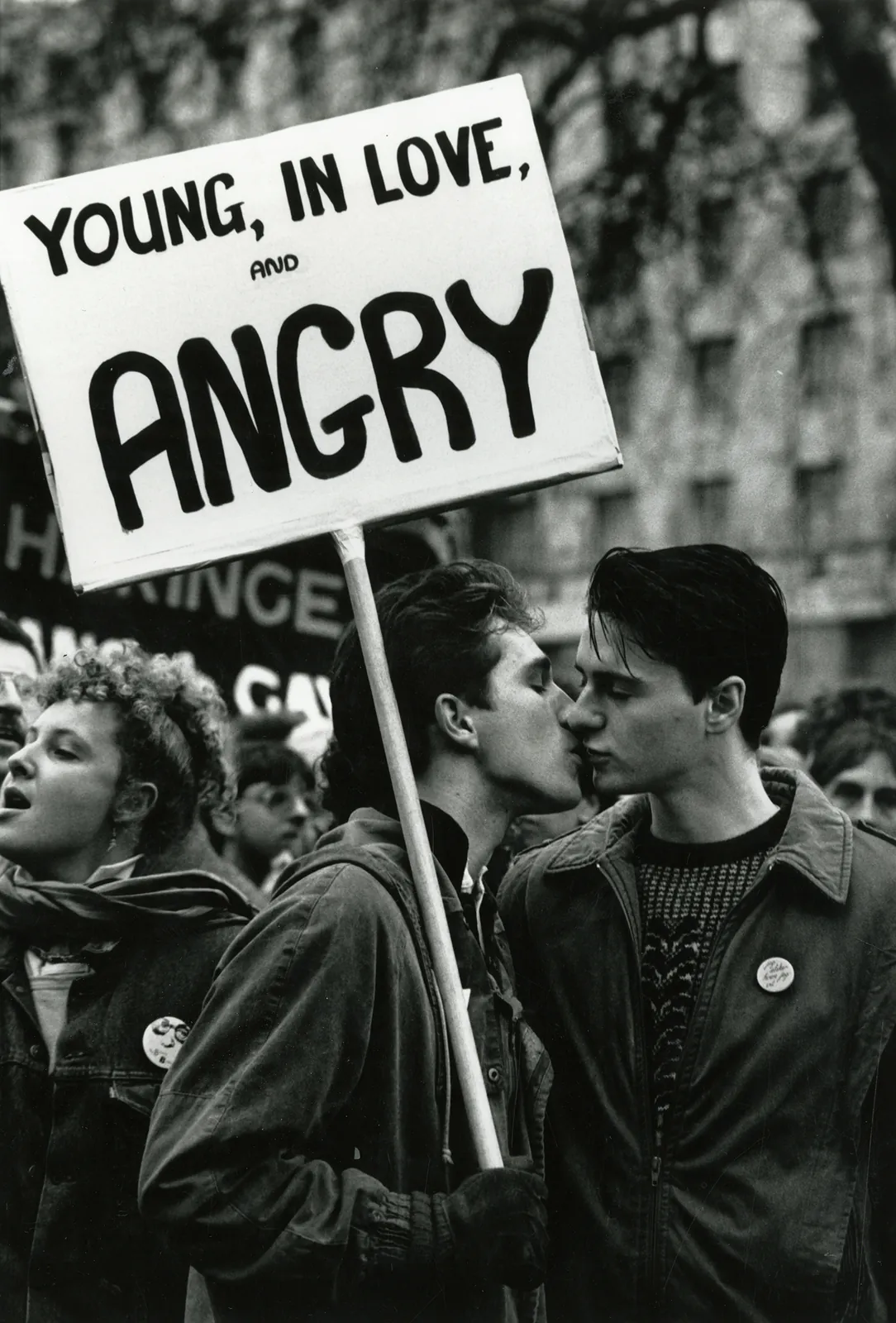
The photograph that stays longest is the quietest. On the Stop Clause 28 march in Whitehall on 9 January 1988, Pam Isherwood photographed two young men kissing beneath a placard that reads, in hand-painted capitals, Young, in love, and angry. Section 28 of the Local Government Act drew the LGBTQ+ community onto the streets together, and Isherwood's picture shows the method: affection performed in public, on the record, as a political act. It is a portrait sitting conducted on a march, and it understands that the camera's presence is the point. The kiss is for the lens as much as for the crowd.
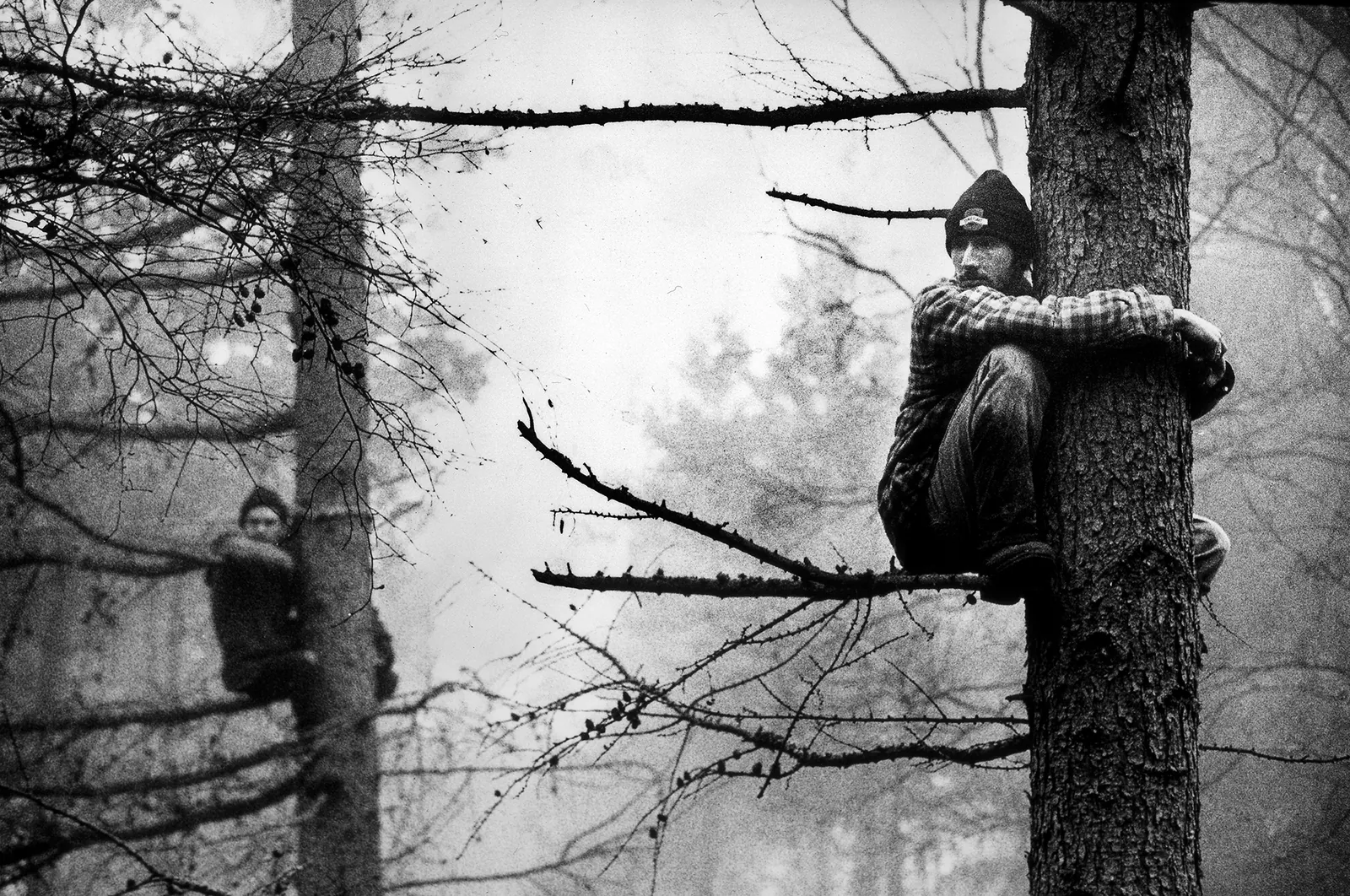
Andrew Testa's work closes the century at the other emotional register, patience. His photographs of the 1996 protests against the proposed A30 Honiton Bypass include a protester seated high in a tree on the route, arms wrapped around the trunk, waiting. Environmental protest made the body itself the obstruction, and Testa's frame, all branches and held breath, shows a form of resistance that works by staying still. Set against the Cable Street arrest at the show's beginning, the distance travelled is the exhibition's real subject: sixty years in which the photographed learned to direct the photograph.
The project took four years to build, supported by the Ampersand Foundation Award 2023, and its political research is by Sarah Harrison. It was organised by and originated at Turner Contemporary in Margate, and Leeds is its North of England venue, following presentations at Turner Contemporary and at National Galleries of Scotland: Modern Two in Edinburgh. A companion publication, compiled by McQueen and edited by Clarrie Wallis with Sarah Harrison and published by 4th Estate, carries the photographs with first-hand accounts and analysis from contributors including Gary Younge, Paul Gilroy and Baroness Chakrabarti. McQueen's own stated hope for the show is modest and exact: "Resistance is an exhibition that will hopefully remind people that no matter the odds, as a collective, things can change."
The criticism the exhibition invites is about selection, and it survives it. A century of protest in one gallery is a canon being proposed, and canons exclude. But the pictures argue back against reverence. They are working photographs, made under pressure by people who expected them to be used, and Leeds has hung them as tools rather than relics. The camera in the crowd is still in the crowd. That is the show's achievement, and its warning.