Portraiture
One Trait, Asked to Carry a Country
Kieran Dodds travelled the United States between 2024 and 2026 photographing people with red hair, and asked each sitter what unites the States. Gingers of America turns a portrait sitting into a civics question, and prints the answers beside the faces.
The cover portrait does the whole book's work in one frame. A young man with red hair sits wrapped in a boldly striped blanket, photographed straight on against darkness, his expression level and unsmiling. The portrait is inset into a cloth cover the colour of ochre, the title stamped in gold foil above it. Before the book opens, its method is declared: one sitter, one trait, full attention.
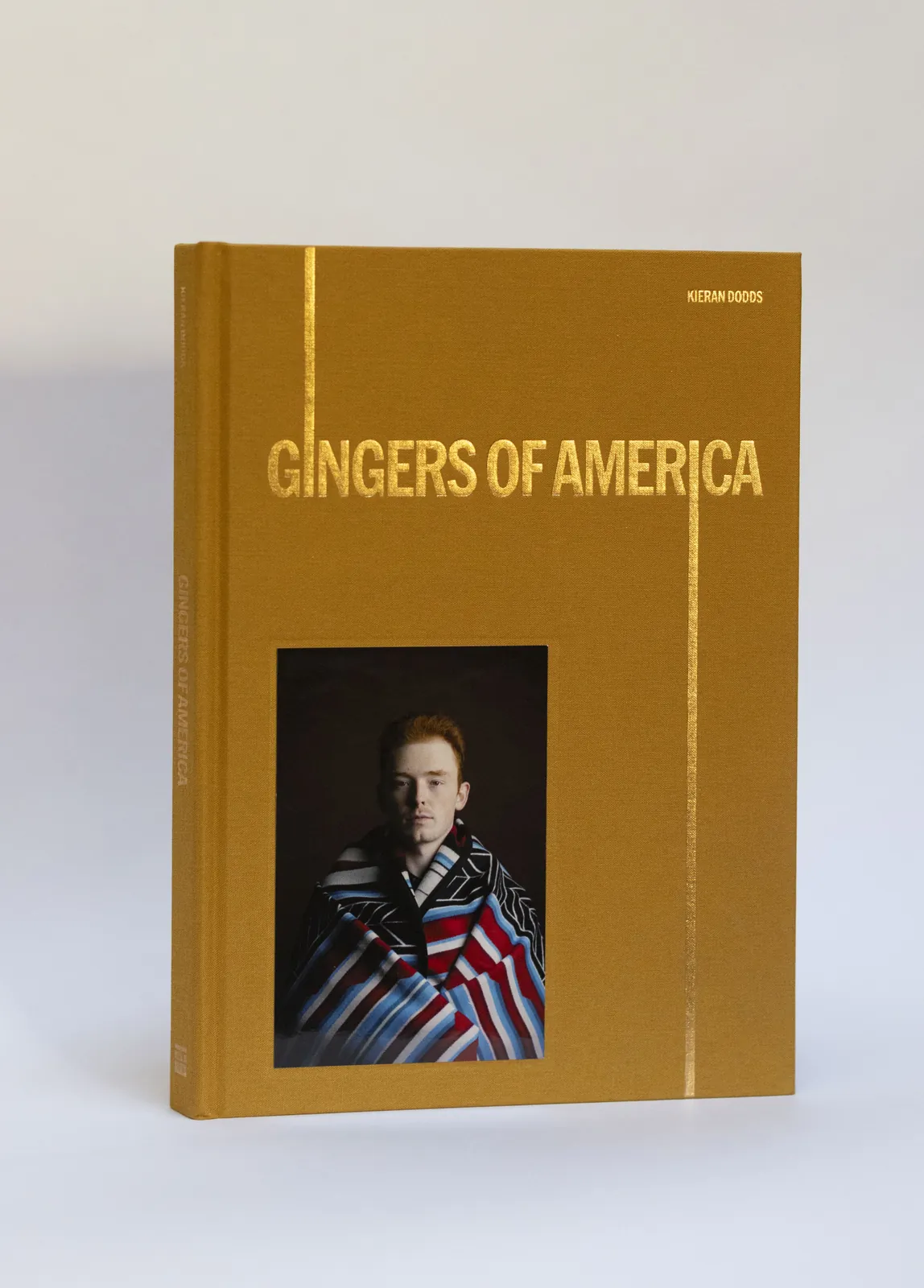
Gingers of America is the new book by the Scottish photographer Kieran Dodds, published by Hide Press in November 2026. It is a sequel to Gingers, his 2020 book of portraits of red haired Scots, and it is his fifth book. The premise travels. Between 2024 and 2026 Dodds crossed the United States photographing people whose hair is red, auburn or strawberry blond, a trait shared by about 1 percent of the global population. He asked every sitter the same question: what unites the States.
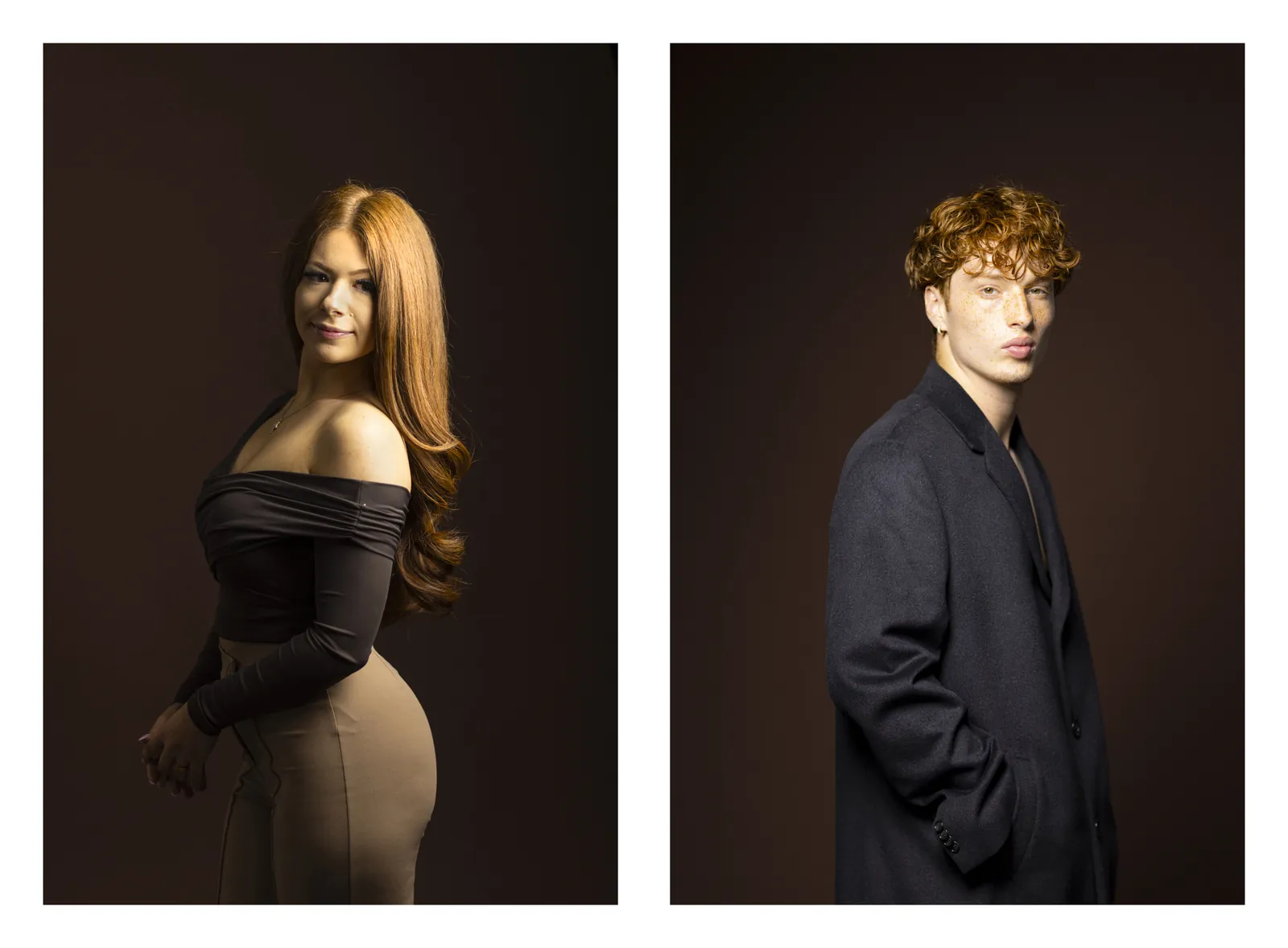
The sitting is the discipline here. Dodds works in a consistent portrait register, sitter centred, background quieted, so that the differences between faces carry the argument. A paired plate in the book sets two sitters side by side, a woman with long copper hair turned over one shoulder and a young man with tight curls in a dark coat, both lit the same way, both meeting the camera on equal terms. The format refuses hierarchy. A barber photographed near Washington, DC gets the same frame as everyone else.
The cover sitter carries the book's most layered story. He is Joshua Elliot of Broken Arrow, Oklahoma, photographed wearing the blanket presented to him by the chief of the Muscogee (Creek) Nation, his tribe. The portrait holds two inheritances in one frame without comment: the trait the book is organised around, and a belonging that has nothing to do with it. That layering is the book's real subject. Red hair is the pretext for the journey. The portraits keep finding the other things people are.
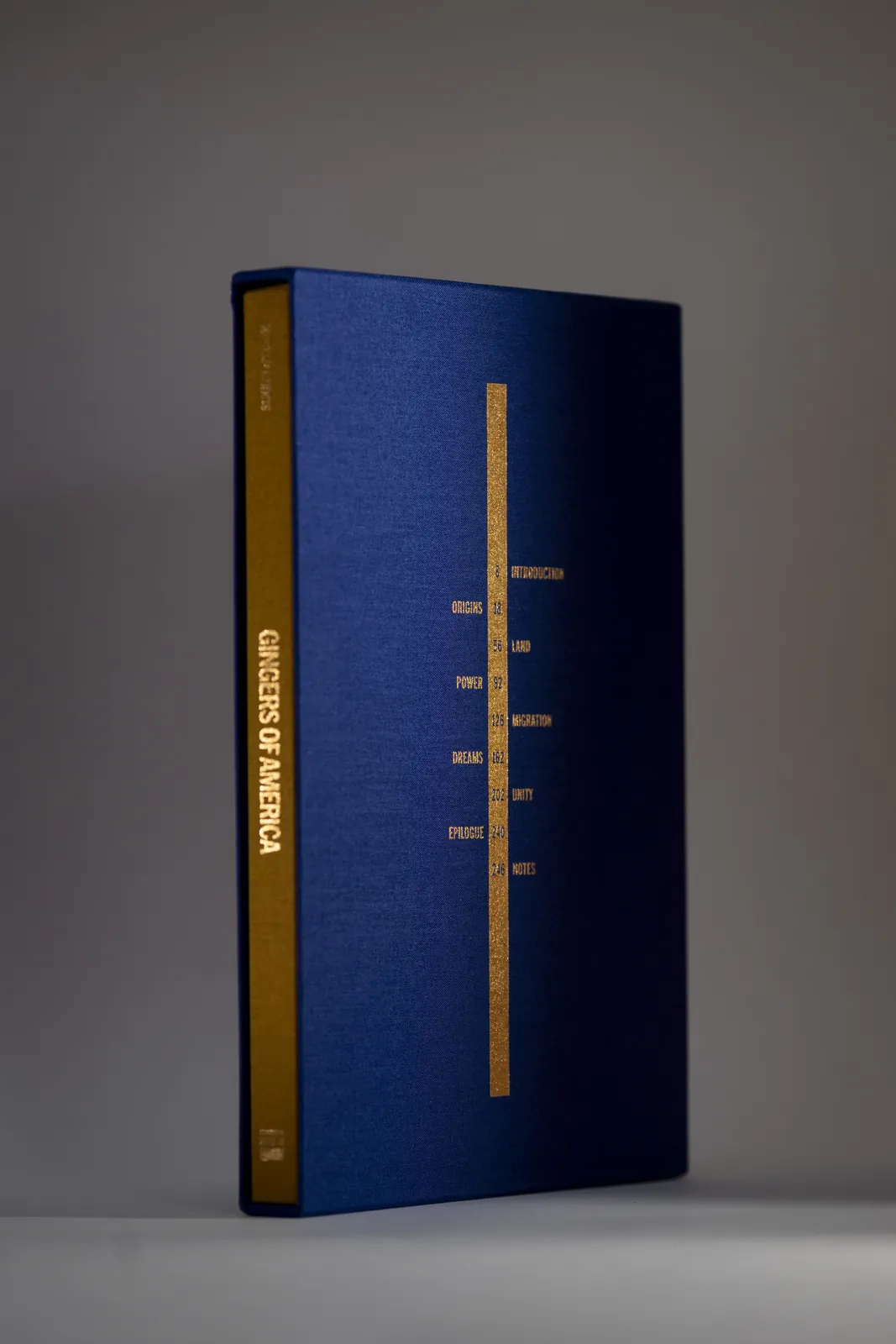
The book as an object is built to be kept: 248 pages, 112 full colour images, 216 by 298 millimetres, cloth bound with a foil embossed hardcover, printed and bound in the USA, in a first edition of 1,500 copies. Its architecture is thematic. The back board prints the contents as a single gold ruled column: Introduction, Origins, Land, Power, Migration, Dreams, Unity, Epilogue, Notes. A portrait book that files its sitters under Migration and Power is announcing that the trait is a lens, not a topic.
Text runs alongside the faces at scale: 10,000 words of essays, and a 90 minute audiobook read by Angus King. The first Gingers series was made in northwest Arkansas, and the project widened after a BBC feature on the first book brought Dodds messages from across the world. The American book keeps that correspondence structure. These are portraits made with sitters who, in many cases, came to the photographer because the trait had already organised part of their lives: the teasing, the pride, the strangers who feel entitled to comment.
Dodds was born in 1980. His earlier books trace a widening circle of the same method: Gingers in 2020, The Church Forests of Ethiopia in 2021, The Little Book of Gingers in 2022, and Now We See: Glimpses of New Jerusalem in 2023. Each takes a defined community and portraits it from inside its own self understanding. The American volume is the largest test of the method, because the community here is defined by nothing but appearance, scattered across a continent, and asked to speak about the country rather than about itself.
That inversion is why the book belongs in Portraiture rather than in travel. The question put to the sitters is not what it is like to have red hair. It is what holds their country together, asked of people who are used to being looked at before they are listened to. More than seventy unique sitters sit for the portraits. Their answers, printed with their faces, make the book a portrait of the States taken from an angle no census uses: unity, considered by the visibly uncommon.
The risk of the premise is whimsy, and the portraits defeat it by register. Nobody is asked to perform their hair. The sittings are grave, frontal and patient, and the cumulative effect is closer to a survey of citizenship than to a novelty album. A trait shared by about one person in a hundred turns out to be a workable sample, precisely because it cuts across every other line the country draws. Dodds found his sitters by looking for the rarest common thing, and then asked them about the commonest question. The book holds because the portraits never blink first.